
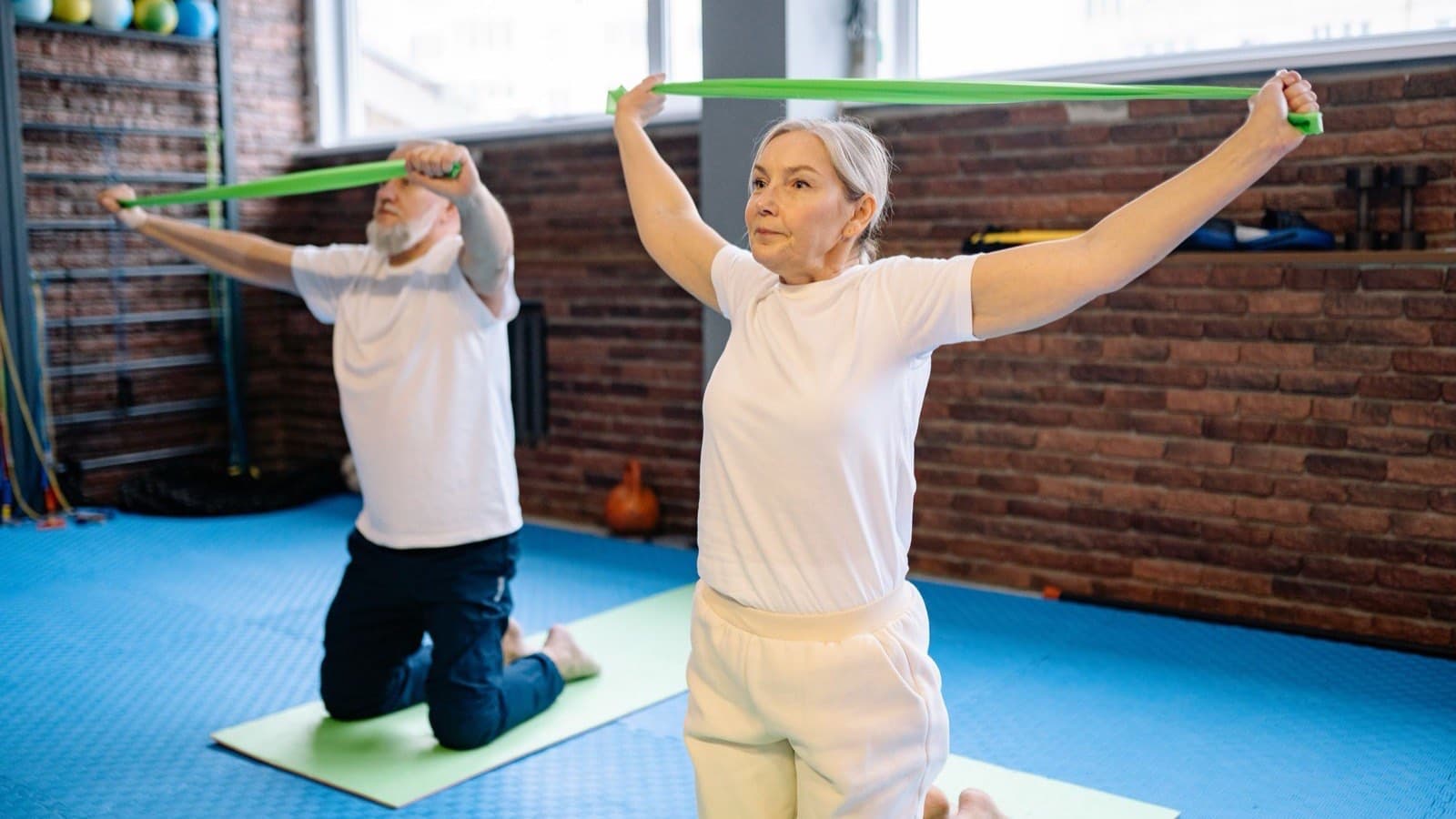
Exercise is both safe and necessary with osteoporosis; what matters is choosing the right movements. Resistance training, impact loading matched to your condition, and balance work strengthen bone and muscle and reduce the risk of falls. Bending the spine forwards under load, and twisting while bent, are the movements to avoid.
Why exercise with osteoporosis?
Bone is living tissue that remodels in response to the load placed on it. Inactivity takes that signal away. Exercise has three goals in osteoporosis:
- Load the bone appropriately: help slow bone loss
- Build muscle: handle daily tasks safely
- Improve balance: prevent falls, a major cause of fractures
Exercise does not replace medication; treatment decisions are made with your doctor. Exercise complements that treatment.
Which exercises help?
| Type | Examples | How often |
|---|---|---|
| Resistance (strength) | Sit-to-stand from a chair, wall push-ups, band rows, light weighted squats | 2–3 days a week |
| Weight-bearing / impact | Brisk walking, stairs, gentle heel drops if suitable | Most days of the week |
| Balance | Standing on one leg, heel-to-toe walking, weight shifting | Briefly, every day |
| Back and posture | Gentle chest lifts lying face down, shoulder-blade squeezes | 2–3 days a week |
The dose of impact exercise is individual. If you have had a spinal fracture or your fracture risk is very high, the programme is built more cautiously.
You can find more on balance work in our fall prevention article for older adults.
Which movements should you avoid?
Spinal fractures usually come from load on the front of the vertebrae when the spine bends forwards. So avoid:
- Sit-ups and crunches: they load the spine in forward bending
- Toe-touch stretches with straight knees
- Lifting with a rounded back: shopping bags, grandchildren, plant pots
- Twisting while bent: especially turning your trunk while carrying something
- Sports with sudden, forceful twisting, when done without control
Instead, learning to bend by hinging at the hips — back straight, hips pushed back — is the single most useful everyday skill.
How to get started
- Assessment first: your bone density result, any previous fractures, balance and muscle strength set the dose.
- Learn the technique: getting up, bending and lifting correctly comes before strength.
- Start light: for the first 2–4 weeks, focus on moving pain-free and with control.
- Progress gradually: when you can do 10–12 comfortable repetitions, add a little resistance.
- Keep going: strength gains are usually noticeable within 8–12 weeks. Bone changes slowly, over months, so exercise needs to become a lasting habit.
The physiotherapist's role
- Designing a programme around your fracture history and risks
- Teaching safe bending, standing up and lifting
- Strengthening the postural and back muscles
- Assessing and training balance and walking
- Managing pain after a spinal fracture and guiding a safe return to movement
Manual therapy in osteoporosis is limited to gentle, carefully chosen techniques; forceful spinal manipulation is not appropriate.
When should you see a doctor?
Contact your doctor before continuing to exercise if you have:
- Sudden, severe back pain after bending, coughing or a minor strain
- Loss of height or an increasingly rounded upper back
- Hip or groin pain after a fall, or being unable to put weight on the leg
- New pain that persists at rest and at night rather than with exercise
- Severe pain in a bone without an obvious cause
These signs raise the possibility of a fracture and may need imaging.
Frequently asked questions
I have osteoporosis — is walking enough? Walking helps, but on its own it does not build enough muscle strength or bone loading. Add resistance and balance exercises.
Are Pilates and yoga suitable? They can be, as long as they are adapted to leave out deep forward bends and twisting while bent.
I have had a spinal fracture — can I exercise? Yes, once pain is under control, but the programme starts more cautiously and progresses under a physiotherapist's supervision.
Doesn't lifting weights increase fracture risk? Resistance exercise done with good technique and progressed gradually is the backbone of osteoporosis programmes. The risk comes less from the load itself than from lifting with a rounded back and without control.
Can I exercise on my own at home? Yes, once you have learned the technique. A few supervised sessions at the start make sure you are doing the movements safely.
This article is for general information and does not replace an examination. For a safe exercise programme tailored to osteoporosis, you can book an assessment at our clinic in Muratpaşa, Antalya.