
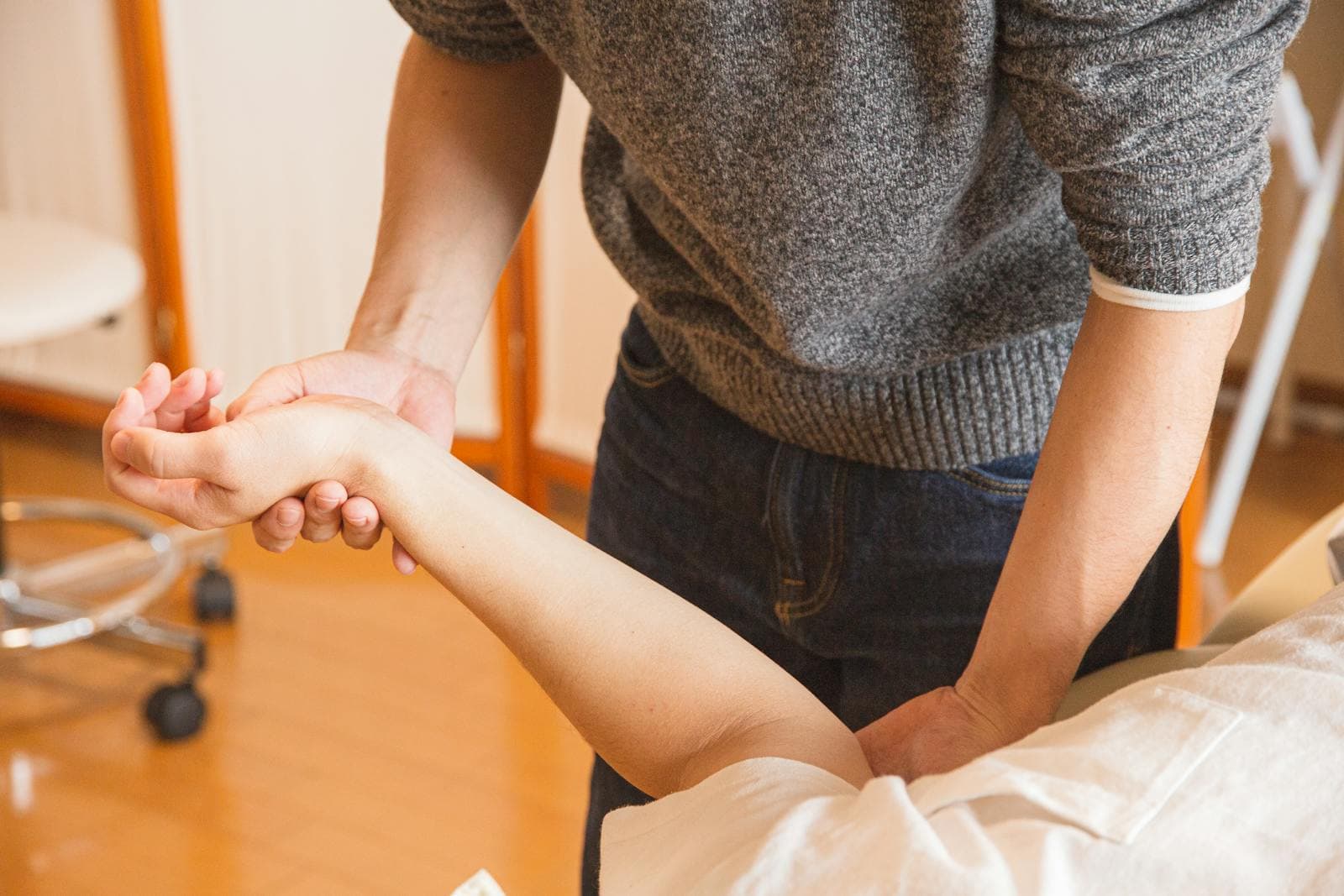
Manual therapy is treatment a physiotherapist applies with their hands alone, without machines, to joints and soft tissue. The aim is to restore restricted joint movement, release muscle tension and reduce pain. In Türkiye it is delivered by physiotherapists who hold a degree in physiotherapy and rehabilitation plus additional certification.
What it actually does
When a joint stays painful for a while, the muscles around it tighten protectively. That tightening restricts movement further, and the restriction feeds the pain. Manual therapy breaks this loop at three points:
- Joint mobilisation: Controlled, repeated, small-amplitude movements applied to the joint surfaces. A tight joint capsule releases and range of motion improves.
- Soft tissue techniques: Sustained pressure, stretching and trigger-point work on muscle, fascia and tendon.
- Neuromodulation: Pressure applied by hand dampens pain transmission at spinal cord level, which is why relief is often felt in the first session.
Manual therapy is not a treatment on its own. The range it opens has to be held with exercise, or the restriction returns within days.
Which techniques are used
| Approach | Focus | Commonly used for |
|---|---|---|
| Maitland | Graded joint mobilisation | Low back and neck pain, shoulder stiffness |
| Mulligan | Mobilisation with movement | Tennis elbow, ankle sprain |
| McKenzie | Directional preference exercise | Disc-related back and neck pain |
| Myofascial release | Fascia and muscle sheath | Chronic neck and upper back tension, fibromyalgia |
| Trigger point | Tender nodules within muscle | Tension headache, upper trapezius pain |
Which technique is used depends on the direction of the restriction found on assessment and on how the pain behaves. Two patients with the same diagnosis may be treated quite differently.
Who it's for
Manual therapy has evidence behind it in:
- Back and neck pain from disc herniation, particularly where movement restriction is prominent
- Frozen shoulder and shoulder impingement
- Tennis and golfer's elbow
- Jaw (TMJ) pain
- Restricted movement in knee and hip osteoarthritis
- Joint stiffness after surgery
- Tension-type and cervicogenic headache
Who it isn't for
Some conditions rule manual therapy out and are always screened for beforehand:
- Active infection or febrile illness
- Advanced osteoporosis, recent fracture
- Tumour or suspected mass in the area
- Uncontrolled bleeding disorder, high-dose anticoagulant use
- Signs of spinal cord compression: loss of bladder or bowel control, progressive weakness, numbness in both legs
That last group needs urgent medical assessment. Physiotherapy comes second.
What a session looks like
The first session usually runs 45–60 minutes, most of it assessment: history of the complaint, which movements aggravate and ease it, range of motion measurement, muscle strength testing and, where needed, neurological examination. A treatment plan follows.
Follow-up sessions are 30–45 minutes. Hands-on work takes 15–20 minutes of that; the rest goes to teaching and rehearsing exercise.
How long until it works
In acute musculoskeletal pain, expect clear relief within the first two or three sessions. Chronic presentations may take 6–12. If nothing has changed after three sessions, the plan needs revisiting — repeating the same treatment is not the answer.
How you'll feel afterwards
Mild muscle soreness or fatigue in the first 24–48 hours is normal, similar to the stiffness after exercise. Pain that increases, wakes you at night, or spreads into an arm or leg is not, and should be reported.
Frequently asked questions
Does manual therapy hurt? You feel pressure, and tender points can be briefly uncomfortable. Unbearable pain is never the goal; intensity is matched to your tolerance.
How many sessions will I need? Typically 6–10. How long you have had the problem, other health conditions and how well you keep up with exercise all shift that number.
Is the cracking sound harmful? The sound comes from gas dissolving in joint fluid and is not in itself a sign of damage. But the effect of manual therapy does not depend on producing it.
How is it different from massage? Massage works mainly on muscle and circulation. Manual therapy targets joint mechanics, is applied on the basis of an assessment, and runs alongside a prescribed exercise programme.
Can it push a disc back in? No. No hands-on technique repositions a disc. Manual therapy reduces the movement restriction and muscle spasm the herniation causes, which lowers pain and makes the healing period manageable.
This article is general information and does not replace an examination. For an assessment specific to your complaint, book an appointment at our clinic in Muratpaşa, Antalya.