
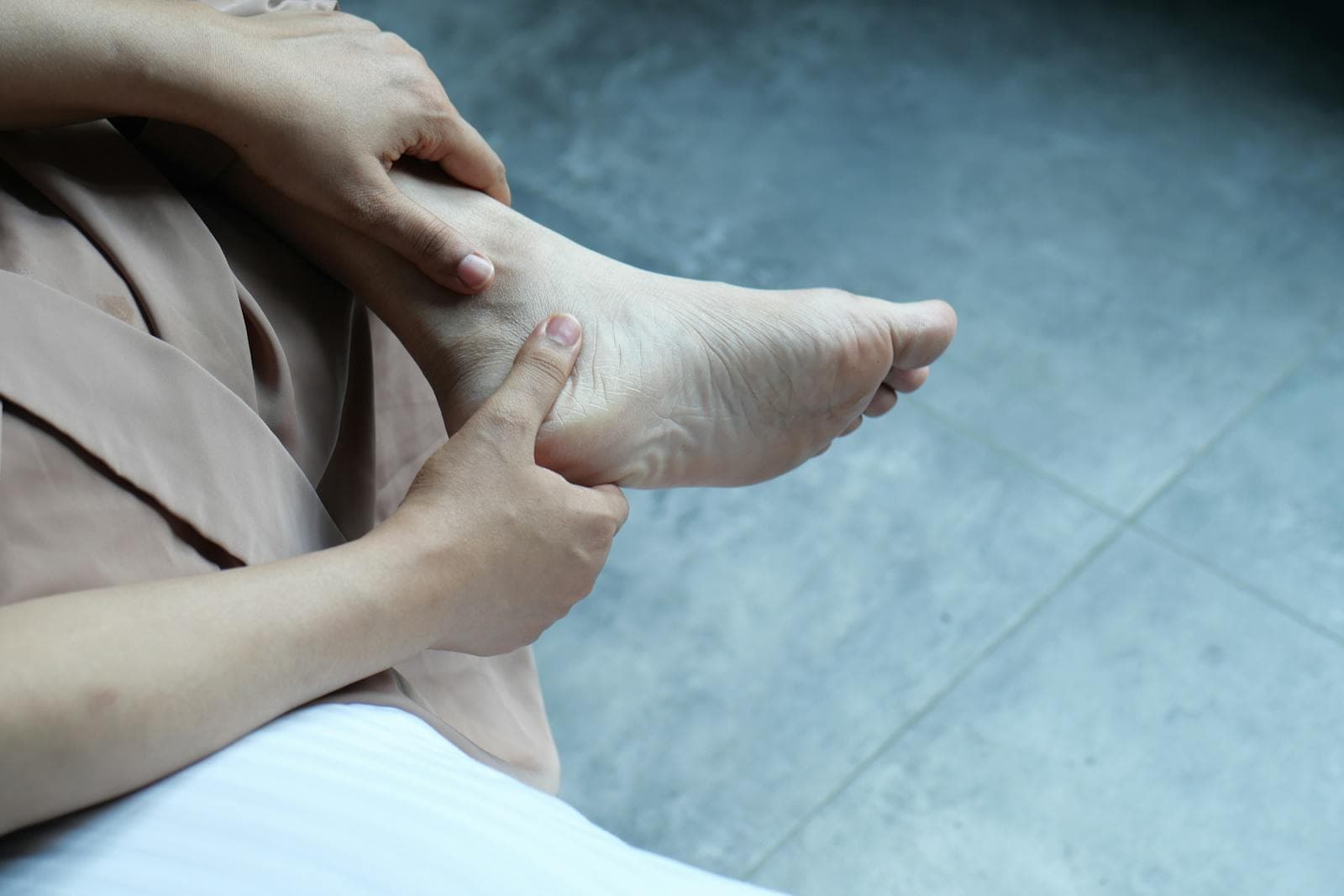
Plantar fasciitis is a painful condition of the thick band of tissue running along the sole of the foot, at the point where it attaches to the heel. Its most typical sign is a sharp heel pain on the first steps after getting out of bed, easing after a few steps and returning later in the day with prolonged standing.
Is the heel spur the cause?
No. A heel spur is a bony outgrowth on the heel bone and is commonly seen on X-ray. However:
- Many people with a heel spur have no pain at all
- Many people with plantar fasciitis have no spur
- Removing the spur does not always resolve the pain
The spur is a consequence of long-standing tension in the fascia, not its cause. Treatment targets the load capacity of the fascia, not the spur.
Symptoms
- Knife-like pain on the inner underside of the heel on the first step
- The same pain returning after standing up from a long period of sitting
- A dull ache building through a day on your feet
- Tenderness on pressing the inner heel
- Increased tension when the toes are pulled upward
If the pain is at the back of the heel and runs along the Achilles tendon, the problem is different (Achilles tendinopathy) and treated differently.
Risk factors
- Restricted ankle dorsiflexion (tight calf) — among the strongest factors
- A sudden increase in walking or running distance
- Long hours standing on hard floors
- Weight gain
- Unsupportive flat shoes, prolonged use of flip-flops
- A flat foot or a very high arch
Treatment: three components
1. Stretching (from day one)
Plantar fascia stretch — the single most effective movement: Before getting out of bed, sit and cross the affected foot over the other knee. Pull the toes up toward you with your hand. Feel the stretch along the sole. Hold 20 seconds, ten repetitions. Three times a day — particularly before the first step of the morning.
Calf stretch: Facing a wall, one foot back with the knee straight and heel on the floor. 30 seconds. Repeat with the back knee slightly bent (for the soleus). Three of each.
2. Progressive loading (from week two)
Stretching reduces pain; loading produces the lasting result.
High-load calf raise: Place a rolled towel under your toes so they stay bent upward. On a step with the heel free, rise slowly (3 seconds), hold at the top (2 seconds), lower slowly (3 seconds).
Start with both feet, 12 repetitions, three sets, every other day. Progress to one leg as it gets easier, then add weight in a backpack.
This protocol produces better results than stretching alone in plantar fasciitis.
3. Load management
- Temporarily reduce running or long walking distance rather than stopping entirely
- Wear supportive shoes indoors instead of going barefoot or in slippers
- Use a cushioned insole or mat if you work on hard floors
Do insoles help?
Off-the-shelf cushioned insoles with arch support can reduce pain in the short to medium term. Custom-made insoles have not been shown to outperform off-the-shelf ones for most patients. Insoles support; they are not the treatment.
Night splints
Splints holding the ankle in neutral help reduce morning pain. Because they can disturb sleep, they are usually trialled for a few weeks in patients whose morning pain is prominent.
How long does it take?
Plantar fasciitis demands patience. With a consistent programme most patients improve markedly within three to six months. In some cases the process extends to a year. Starting treatment early shortens it.
Corticosteroid injection
It reduces pain in the short term. Repeated injections carry a risk of thinning and, rarely, rupture of the plantar fascia. It is considered in selected cases that have not responded to a loading programme.
Frequently asked questions
Should I stop walking altogether? No. Complete inactivity lowers the fascia's load capacity further. Keep walking distances that do not carry pain into the next day.
Ice or heat? Ice during the acutely painful phase — rolling a frozen bottle under the foot is soothing. Brief heat before the morning stretch can reduce tension.
Which shoes? Shoes with a slight heel rise (10–12 mm), a sole that is not too flexible, and arch support. Completely flat, thin-soled shoes make it worse.
I have it in both feet — is that normal? It can be bilateral. However, bilateral heel pain can also be associated with some rheumatological conditions, so medical assessment is advised if other symptoms are present.
This article is general information and does not replace an examination. For heel pain, book an appointment at our clinic in Muratpaşa, Antalya.