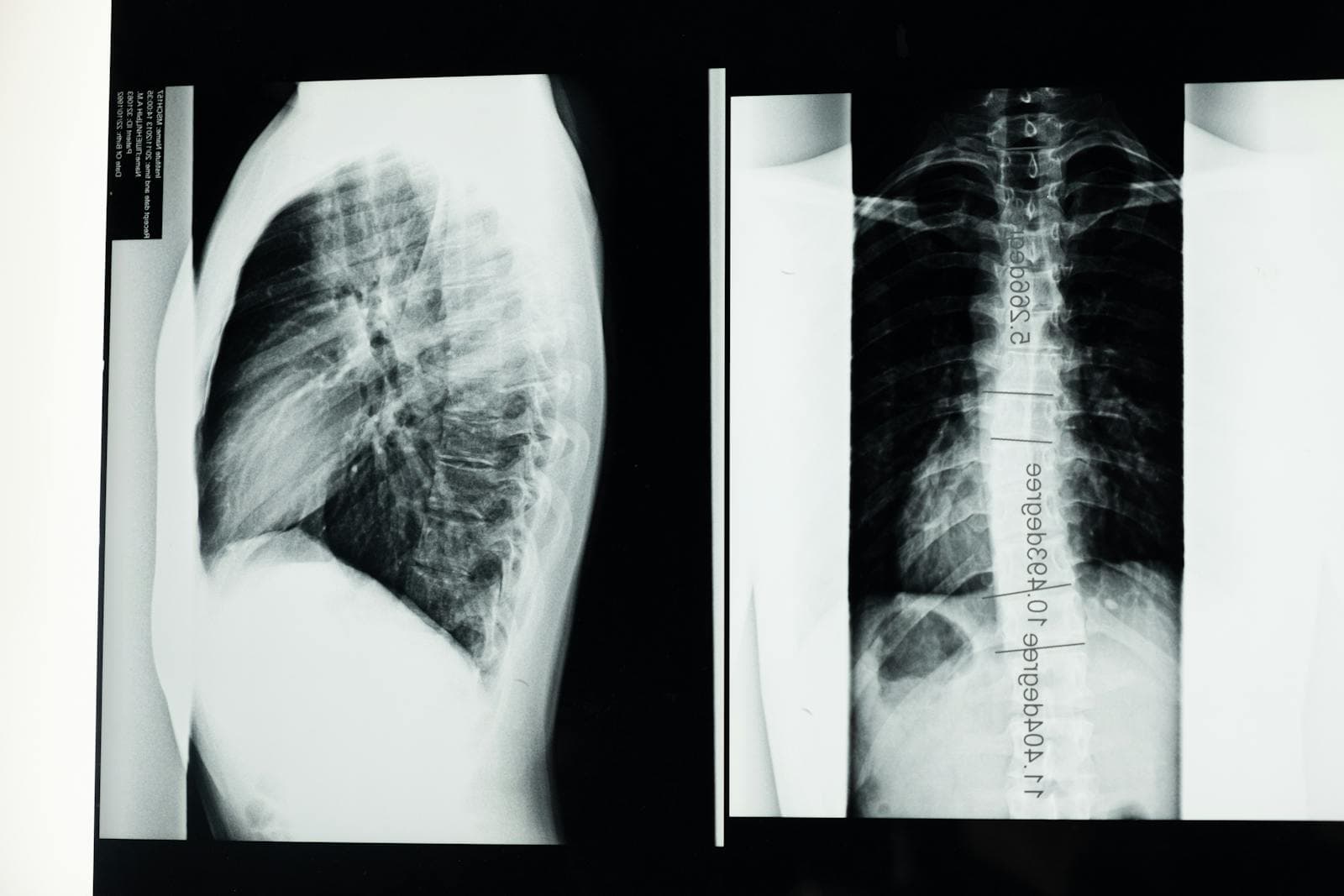
Scoliosis is a sideways curvature of the spine combined with rotation around its own axis. Diagnosis requires a Cobb angle above 10 degrees on X-ray. The large majority of cases are idiopathic — no identifiable cause — and appear during adolescence.
How it is noticed
Scoliosis starts painlessly, so it is usually spotted visually:
- One shoulder higher than the other
- One shoulder blade more prominent
- Asymmetric waist creases
- Unequal gaps between the arms and the body when standing
- A skirt or trouser hem hanging to one side
- One side of the back rising when bending forward (rib hump)
The Adams forward bend test
The most practical home screen: the child stands with feet together and knees straight, then bends forward with the arms hanging freely. Viewed from behind, one side of the back sitting higher than the other indicates rotation and warrants medical assessment.
Causes
- Idiopathic (around 80%): Cause unknown, usually becoming apparent during the growth spurt between 10 and 15. A family history raises the risk.
- Congenital: Present from birth due to a vertebral formation defect.
- Neuromuscular: Seen alongside conditions such as cerebral palsy and muscular dystrophy.
- Degenerative: Appearing in adults through disc and facet joint wear.
Backpacks, poor sitting and carrying with one arm do not cause scoliosis. They may make an existing curve more visible, but they do not start one.
Treatment follows the Cobb angle
| Cobb angle | Approach while still growing |
|---|---|
| 10–20° | Monitoring plus scoliosis-specific exercise; review every 4–6 months |
| 20–40° | Bracing plus exercise; brace worn 18–23 hours a day |
| Above 40° | Surgical assessment |
Once growth is complete, curves under 40 degrees are much less likely to progress, and the focus shifts to pain management and function.
What the Schroth method is
Schroth is the best known of the scoliosis-specific exercise approaches. What separates it from general back exercise is that it targets three-dimensional correction matched to the individual curve pattern:
- Elongation: Actively lengthening the spine along its axis
- Rotational breathing: Using the breath to expand the collapsed rib spaces
- Stabilisation: Holding the corrected position with muscular activation
Exercises are selected according to the curve type; giving everybody the same programme does not work. Applied consistently, it can help slow progression and reduce trunk asymmetry.
What to know about bracing
- A brace is worn to stop the curve progressing, not to correct the existing one.
- Its effect depends directly on daily wearing time; a few hours a day will not deliver the expected benefit.
- Exercise continues alongside bracing — essential, since a brace can weaken the trunk muscles.
- It is weaned gradually once growth is complete.
Bracing is psychologically hard for an adolescent. Talking about wearing time openly, rather than hiding it, and planning around school hours markedly improves adherence.
Adult scoliosis
In adults, reducing the size of the curve is not the goal. The goals are:
- Reducing back pain
- Strengthening trunk and hip muscles to support the spine
- Preserving walking distance and daily function
- Managing nerve symptoms where leg pain is present
In adult degenerative scoliosis, pain usually comes not from the curve itself but from accompanying canal stenosis and facet loading.
About sport
A child with scoliosis should not be kept away from sport. Swimming, cycling, running and team sports are all fine. Where a sport involves heavy one-sided loading — gymnastics, diving, weightlifting — coordination between coach and physiotherapist is sensible.
Swimming alone does not correct scoliosis. This is a common misconception. It is valuable for general conditioning but does not replace scoliosis-specific exercise.
Frequently asked questions
Will it get worse? The risk of progression is highest during rapid growth and in curves that are already large. After growth finishes, the risk drops considerably.
Can exercise straighten the curve completely? A structural curve does not fully resolve with exercise. The aim is to slow progression, preserve trunk balance and breathing capacity, and prevent pain.
How often should X-rays be taken? Usually every 4–6 months during growth. Keeping follow-up with a single clinician avoids unnecessary repeats.
Does it hurt? Adolescent idiopathic scoliosis is usually painless. Significant pain prompts a search for another cause.
This article is general information and does not replace an examination. If you have noticed asymmetry in your child's back, book an assessment at our clinic in Muratpaşa, Antalya.